Thursday, May 15, 2008

June 2008 Atalas, Zebras, Dragons and PANDAS!

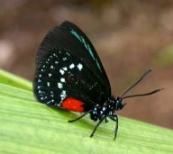
Coonties everywhere are a-bloom with the bright red and yellow atala larvae, causing consternation or joy depending on the owner of said plants. Home owners exalt when they see Atala the Hun at work, but landscapers and city planners often struggle with wanting to help keep a species stable….and wanting to protect their ornamental edging from being destroyed by the larvae.

An enlightened city planner would make interpretive signs explaining the unique history of this once-thought extinct insect and its beautiful but poisonous host plant. At the very least, a city planner could call on the atala “rescue teams” and have one of us move the offenders to a safe location, thereby establishing another atala colony.

Dick Freshley at Okeeheelee Nature Center asked if there is a way to differentiate male and female atalas other than the upper surface of the wings. Males have a splash of iridescent greenish-teal-blue on the upper surface and females have a streak of bright royal blue on the upper wing surface. It can be difficult to see the colors when they are fluttering by.

This is the upper forewing surface of a male--notice that there is more diffuse softer greenish-bluish color over a larger area.


This is a female’s upper forewing surface—you can see that the color is concentrated and is a streak of bright royal blue (not a diffuse wash of color).


But yes, there IS another way to sex the atalas!


Males have a very dark spot on the very tip of the abdomen which leads to scent glands located within. When the male is courting a female, he will evert these brush-like glands to release pheromones that he hopes will attract the female.


This is a photo of the male with the scent glands everted. The female was just out of camera range.


Female atalas, on the other hand, have a smaller lighter spot on the tip of the abdomen, which leads to the ovipositor (which she uses to lay her eggs). So now you have two ways to identify the males and females.


In the process of capturing these atalas for the impromptu photo shoot, I was surprised to miss several in a row---They are notoriously easy to catch!
“How did I miss another one?” I asked Dr Joshua Feingold, who was kind enough to take these photos for me in the NSU Mesozoic Garden.


Zebra Heliconius was also fluttering everywhere in the Medicinal Garden, next to the atala's garden.


The Corky Stem Passionfruit was flowering, and females were laying the delicate gold eggs on the tips of the new growth. Larger larvae were happily munching.


A beautiful Golden-winged Skimmer (Libellula auripennis) was using one of the decimated milkweed stems as a look-out perch the other day. What a vibrant dragonfly! And another Golden-winged was ‘captured’ at John U Lloyd Beach State Park, too.

It looks like summer programs at John Williams Park will remain as exotic plant workshops and not the fun activities I had hoped for…liability insurance is not affordable for the small numbers of children expected to attend. Maybe next year!

In the meantime, I am helping Dr. Barry Barker and the Wildspots Foundation with fund-raising for the earthquake-stricken Wolong Panda Institute news, located near Chengdu in China.
We have been told that although the pandas are safe, the access to them is impossible because the road to Wolong has been completely destroyed and damage throughout the area is severe. Wolong will be closed until next Spring because of the accessibility issues. Chengdu Panda operation in Chengdu needs help. Wildspots is sending volunteers there Sept 19-28. If you would like to volunteer for the trip to help, or buy a beautiful photographic book (this photo is by Tom Isgar, one of the photographers in the book) being published by Wildspots to raise money for the panda preserve, go to the Wildspots website or email Dr. Barker directly: barkerb@wildspotsfoundation.org.

And please remember that your help removing exotics is appreciated at John Williams Park, 6101 Sheridan Street this coming Saturday, May 24, 2008 from 9 AM-noon!

Labels:

Thursday, May 01, 2008

May 2008 Atala News

Colonies everywhere are coming back to life after a hiatus during much of the winter season. This is in keeping with data I’ve collected over the years; summer will be bringing irruptions at many colonies and all of us “atala-sponsors” will soon be getting calls to help people re-distribute the excess to other sites. This is a great way to start new colonies, if all of the essential habitat requirements are in place for the atalas: coontie for the larvae, and shady spots and nectar sources for the adults. NSU’s garden has a new influx of pupae, many of which are hanging out on the Horsetail in the Mesozoic Garden on campus.

Good news for atala fans: my note, "Nectar Sources for Eumaeus atala," was published in Florida Entomologist in March 2008 and is now on line and accessible for all to download and read. Happy planting!


We had a successful but subdued Earth Day program at John Williams Park in Hollywood on April 25th...Sean and his beautiful canine companion Powder were our only volunteers, but we accomplished a lot in our day! We installed three native White Plumbago plants in the open area of the park that volunteers from Columbia and Hollywood Hills High School had previously cleared of exotics in January, after removing the new crop of invasive seedlings. Then we planted two White Twine Vine seedlings and two Elderberry seedlings in the wetlands of Sheridan Oak Forest. All of these plants are compliments of Art Constantino, Broward County Master Gardener. (Thanks, Art!)
There is a new charge of invasive seedlings in both John Williams Park and Sheridan Oak Forest, however---we are in desperate need of volunteers for the May 24th program! Please find some time to join us at 9 AM in the parking lot at John Williams Park, 6101 Sheridan Street.

We had a lot of legitimate competition from the wonderful programs in Broward County for Earth Day: I am sure that residents learned a lot and had a great time at the many other events being sponsored throughout the county….I do have to extend special thanks to Sean and Powder for showing up to dig in the dirt for this program, though!

I spent some time with my very dear friend Dr. Sarah Meltzoff in Sheridan Oak Forest and we found (as always) some new plant species. We also came across a very deceased young raccoon, for which we gave a decent forest burial.


I know that a Red-Shouldered Hawk hangs out in the clearings of the forest, so it is possible that he took advantage of an inexperienced forager.


Jessica Smith, volunteer extraordinaire at John Williams Park, is accepting her Girls Scout Silver Award on May 6th, after two years of dedicated work. Congratulations, Jessica!


Our Spring Butterfly Count went very well at Hillsboro Pineland Natural Area. We saw over 20 species of butterflies and had a great lunch break with NABA friends. These are our sun-lit participants for the morning count, surrounded by the lush pineland understory. We also got to watch a Pileated Woodpecker busy calling for companions, and that was a rare treat in the urban environment around Hillsboro!

I was privileged to present a PowerPoint, “Butterfly Migration through South Florida: Beyond the Monarch!” at the monthly meeting of the Broward County Butterfly Club chapter of NABA in April. If you missed this presentation, I have been invited to repeat the program for the Miami Blue NABA Chapter at a future date. I’ll be posting on that
soon!

Speaking of Miami Blue , one of my special friends from Florida International University, Dr. Suzanne Koptur, presented a fantastic program for the Miami Blue NABA chapter on Sunday, May 4th at 1 pm, at Castellow Hammock Preserve in Homestead. We enjoyed the chance to see the delightful hammock and butterfly garden, as well as hear Suzanne's great presentation about Sulphur Butterflies, and the ants and parasitic wasps that co-occur. Complicated relationships go on that we seldom witness! Castellow Hammock Preserve 22301 SW 162 Avenue, Miami FL. 305-242-7688.
This is me, Elane Nuering (VP of Miami Blue NABA Chapter), Michelle Briois, Roger Hammer (who re-discovered the atala on Virginia Key in 1979), Suzanne Koptur (FIU Biology faculty) and Barbara DeWitt (NABA Broward County). Al Hart, Barbara's husband, took the photo.
(Thanks, Al!) It is always such a pleasure to be with butterfly people.


And this is one of the fat Tree Snails at Castellow!

I’ve also been having a great time in the Everglades! The kids from Miami Day Country School and I visited ENP three times. It is so much fun to be in the Everglades with people who know how special and unique the experience is. Their instructor Rowena Gerber teaches Enrichment Classes and the children impressed me with their knowledge of South Florida eco-systems. Do YOU know all seven special ecosystems? (Answers below.)

I also had the opportunity to visit the River of Grass with my Aunt Rose and her husband Art, who were visiting from the cold gray north (as in Rhode Island)! It was one of the few times I’ve actually been able to photograph the “glades” themselves (I am usually busily leading a tour and explaining things, so this was a rare treat!)

I also spent an afternoon at West Glades Middle School in Parkland speaking to the Environmental Club about the atala. Their teacher Jamie Luft and the club had planted a beautiful atala butterfly garden at the school, and had done a lot of research themselves about this vulnerable hairstreak, but still had a barrel of questions! I gave them copies of butterfly gardening literature from the Extension Office, a copy of the nectar sources article I wrote for the journal Florida Entomologist, and told them where to find more material on butterflies in general. They gave me a great book bag, which I have used many times already, and a pin that the club made up, “Save the Atala: Plant a Coontie”!

John U Lloyd Beach State Park has been another constant companion for the past month, as I am helping Dr. Ed Keith with the chapter on the ecosystem vegetation for the book he is writing about this coastal barrier island ecosystem. Even though my ‘job’ is to photograph plants, I am frequently side-tracked by the wildlife!
This Mangrove Skipper was a distraction!


And so was our native little gray squirrel in his natural habitat (a tree), but one of his relatives decided that French fries from the café that he found in the restroom dumpster were more interesting. The French-Fry Bandito was caught in the act of munching. I hope it doesn’t affect his cholesterol the way it does humans!


This Gulf Fritillary was nectaring on Bidens alba, a ubiquitous weed, but a very important nectar source for butterflies. (Consider leaving a section of your yard wild for the wildlife!)

And this beautiful six-lined race runner allowed me to take his
photograph! As did this Brown Anole, who was very cooperative.


But I had to PLEAD with this very shy Barred Yellow Butterfly for fifteen minutes to allow me to take a photo!


This grasshopper, so eloquently camoflaged in the "Australian Pine mulch", was not quite so difficult to capture on film, however. Difficult to SEE in the mulch, but cooperative!


Our stately Brown Pelican was proud to have his image captured, too, and posed majestically on his podium! The Tree Snail was more subdued, but just as beautiful.


OK, I did photograph vegetation, too (over 600 photos!) Aren't these nested Nickerbeans gorgeous?! And the Seaside Oxeye Daisy? Splendid!


Fortunately, even the tiniest corridor is home to our wildlife: This Horace's Duskywing visited my little corner of the Universe this week, taking advantage of the Cordia globosa. I have even seen Hummingbird Moths visiting!

I am planning a plethora of activities and programs for the summer season for children through the City of Hollywood Parks, Recreation and Cultural Arts Department. If you know any children in Middle School (8-12 year age range) that want to spend time learning about Oak Hammocks and other ecosystems, identifying butterflies, snakes, spiders, birds and plants in the field, playing really fun nature games, I’ll be posting that information as soon as possible!

I hope to see YOU at the next NABA count taking place in June and July! The South Circle Count, at Tree Tops and Long Key is planned for Sat. June 14, 2008.

The North Circle Count, at Hillsboro, Crystal Lake and Hugh Taylor Birch is planned for Sat. July 12, 2008.


Next NABA Broward meeting is May 8, 2008, at the Extension Office on College Avenue in Davie.


Until next time, BEE HAPPY!

(Seven South Florida ecosystems: Lake Okeechobee, Everglades Sawgrass Prairie, Big Cypress, Hardwood Hammock, Florida Bay, Pine Rockland and Mangroves/Coastal.)

Wednesday, March 26, 2008

April Atala News and Events


One of my favorite quotes by Albert Einstein is called to mind this month: “The most beautiful thing we can experience is the mysterious. It is the source of all true art and all science.”

I hope to see you at one of the events scheduled.... mysteries and art abound!

April 10, 2008. 7 PM, at the Broward County Extension Office, I’ll be speaking at the North American Butterfly Association meeting on “Butterfly Migration in South Florida: Beyond the Monarch.” Come learn about the other species--36!-- that migrate through South Florida, as well as the latest info on the Monarch’s unbelievable flight. Scientists have discovered a lot of new information about how they navigate hundreds, or thousands, of miles and the news is not only fascinating—it’s miraculous!

April 12, 2008: Join us for the annual NABA Spring Butterfly Count! Experienced and novice participants, and children, are welcomed alike. We have three counts taking place in the North Circle:

Hugh Taylor Birch State Park, 3109 E. Sunrise Blvd, Fort Lauderdale. Contact Janice Malkoff at Cycad49@aol.com to RSVP.

Hillsboro Pineland Natural Area, US 441 and NW 74 Place, Coconut Creek. Contact me at sandykoi@bellsouth.net to RSVP.

Crystal Lake Sand Pine Scrub, 3299 NE 3 Avenue, Pompano Beach. Contact me at sandykoi@bellsouth.net to RSVP.

We will be counting from 9 AM to noon, breaking for lunch at a near-by restaurant and then continuing for the afternoon until about 3 PM. You do not have to do both morning and afternoon counts. Bring plenty of water, snacks if you wish, sunscreen, hat, and be prepared for the great outdoors. Wear comfortable walking shoes, and I also suggest wearing long-sleeves just in case... We seldom need “bug repellant” and if we do, I will have some with me. You may want to bring a camera, and binoculars, too!

The seasonal butterfly counts help us keep tabs on the fluctuations in populations, and determine when a species is at high risk. We can’t emphasize how important these counts are!

April 26, 2008. John Williams Park/Sheridan Oak Forest Natural Area, 6101 Sheridan Avenue, Hollywood, Invasive Exotic Plant Workshop, 9 AM-noon. You will learn some of our native plants, see and walk the new Nature Trail, and help dedicated volunteers remove the invasive plants from along the trail. Dress for serious work (suggested attire: long sleeves and pants, tennis shoes or boots--no sandals!) I’ll have insect repellant as mosquitoes are frequent in the hammock. Bring water, a snack if you wish, and a hat and sunscreen. If you’ve never been to John Williams, take the time to visit this gem of beautiful oak hammock nestled amidst the concrete jungle of Hollywood.


We installed the new signs this month along the trail: we are ready for business! That's Jack Mathison, Assistant Director of Hollywood Parks, Recreation and Cultural Arts, and me, with the signs we designed. Each sign has my photographs and a little information about the plants and animals on the sign.

And every time I visit the park, something new shows up! This time, it was a beautiful female Horace's Duskywing, and a very pale Green Anole. A Red-Shouldered Hawk was causing all the Blue Jays and Mockingbirds to raise a fuss, but the bird was too fast for me to capture on film! This little guy is a ring-necked snake; he is so delicate!
(The next workshop is May 24, 2008. We will break for the summer until next fall.)


I’ll also be accompanying Middle School children from Miami Country Day School to Everglades National Park several times this month and next! They’ve been studying the Everglades ecosystems for weeks and are finally ready to visit the real thing. They will be making Nature Journals, and I’ll be posting pictures! We found this beautiful orchid in the Pine Rock Lands and is called Grass Pink (Calopogon tuberosus). Here's a photo of the kids enjoying their first view of alligators and Black Vultures!


By the way, I did get an “A” in Everglades Ecology (whew!) and making a journal was part of the fun for the class. I like looking back in the journals and remembering all the wonderful things I did and saw in my field classes.

I also spoke to the John Knox Village Garden Club on March 24, 2008, giving what has become my ‘signature’ presentation, “Butterflies, Botany and Battlefields.” The residents are involved with their butterfly garden with a passion and it shows. They have a pine rock land area and are considering adding more coonties to establish an atala colony!

Speaking of which, my friend Roberta Shaw (whom I first met a LONG time ago when we both worked at the Wildlife Care Center), informed me that Broward Community College is also housing an atala colony! The butterflies self-established near the Art Department. BCC is across the street from NSU and UF....the corridors are getting established in Davie without any other human help but installing the right plants! Tree Tops Park and the Pine Ridge have had atalas for a long time, thanks to the aware staff at Tree Tops, and residents in the Pine Ridge community.

Atala populations are doing well in most colonies again…the winter slump is ending and the butterflies are flying again. Alana Edwards in Palm Beach County, president of the Atala Chapter of NABA, wrote that Bob Pyle (the founder of Xerces!) visited South Florida this month and spent hours watching the atalas in her colony as they did their butterfly things. Bob is traveling throughout the United States for the next year and documenting all the butterflies he meets in order to raise money for Xerces. Visit the site! Alana has some wonderful photographs of the Martial’s Hairstreak and atala, as well as Bob writing as he watched some of Alana’s atala’s emerge. Bob's journey and experiences are something in which all of us wish we could indulge and which all of support wholeheartedly!

Friend Dick Freshley from Okeeheelee Nature Center sent some awesome photographs, too. The colony is flourishing and he asked about the odd “whiskers” he could see on the atala eggs. These are scales containing microscopic spicules from the abdomen of the female’s body that are released as she oviposits. The scales contain the same neurotoxins that she ingested as a caterpillar from the coontie plant, and are sequestered in her body. The spicules around the eggs act as a protective mechanism against most predators. Some ants, however, sneak in between the scales and attack the eggs. Dr. Eileen Smith-Cavros at NSU first documented this predatory behavior in 2002 as a Master’s student at Florida International University.

Dick writes that he has been showing visitors to park the atala eggs under a dissecting microscope and awakening them to the beauty and incredible details. The eggs remind me of a birthday cake decorated with sprinkles…I urged Dick to continue bringing this magic to his visitors. Even the tiniest fly, no bigger than a speck, has the most intricate and delicate details when seen through a microscope. Some have striped antennae, soft feathery filaments around the wing edges, and other minutiae that would astound you. This is one reason why scientists become so enamored with their work.

Nature is incredible! Another Einstein quote comes to my mind: “There are two ways to live: you can live as if nothing is a miracle; you can live as if everything is a miracle.” Everything I see reminds me every day that Life in all its forms is a miracle.

Friday, March 07, 2008

Atala News March 2008

I was the Teaching Assistant for the NSU field trip to Myakka State Park and Venice Beach for Dr. Joshua Feingold’s Marine Biology students this month; it was great! (Plus it was my birthday, so this field trip was like a birthday present!) At Upper Myakka Lake, we witnessed an adult Bald Eagle sitting on the ground for quite a while…What was it doing? What we didn’t realize, until a moment later, was that the eagle was focused on an osprey that was cruising over the water. When the osprey caught its’ fish, the eagle lifted off and chased the osprey until it released its catch of the morning. The eagle then caught the fish in mid-air, and was then immediately chased by an immature eagle until they flew out of sight—perhaps an offspring, still looking for a free meal. What can be deduced is the old maxim: No honor among thieves!

We also saw an adult wild boar (or sow) foraging on the opposite shore, and a turkey foraging in the grasses, as well as the ubiquitous alligators. Limpkins were searching for apple snails, and we found plenty of ‘de-snailed’ shells along the shore, proving that the limpkin was successful, and that there is a healthy snail population at Myakka. The snails were not our native apple snail species, but fortunately neither the limpkin nor the endangered Snail Kite seem to care. The ancient oaks were a main attraction to the students as well!

Sandhill Cranes were seen flying overhead, and there were plenty of Florida’s beautiful wading birds—Tri-color, Great Blue, Little Blue and Green Herons, Snowy and American Egrets, Glossy and White Iibis. Also seen: Carolina Wrens, Black and White Warblers, Red-Shouldered Hawks, Skimmers, Blue-Winged Teal ducks, Anhingas, Cormorants, Black Neck Stilts, and Wood Storks.

An interesting luncheon was observed as a small group of Black Vultures snacked on a dead Soft-Shell Turtle (Apalone ferox). That's Dr. Feingold taking close-ups of the event.
And smaller critters, too: this pretty but deadly bloodsucking “Assassin Bug” (Triatoma sanguisuga). This female Brown Anole (Anolis sagrei) stayed still long enough to snap her photo.


These photos of me, the shark teeth and shark egg cases are compliments of Dr Feingold.


At Venice Beach and Manasota Beach, we saw White Pelicans, Brown Pelicans, Ruddy Turnstones, Least Sandpipers, and Short-billed Dowitchers--all in all we saw 28 species of birds in our two day adventure! But, only one butterfly to list: the Queen. The rack line provided plenty of sea shells for the students to identify, as well as shark egg cases, sponges, Gorgonian sea fans, corals, sea beans, sea weeds, amphipods, and living mollusks.


Everyone went home happy despite the rainy weather and very long drive…because everyone went home with a small collection of shark’s teeth and intact shells from the shores famous for them…one has to wonder how many sharks there must have been at one time: for over a hundred years tourists have been collecting the teeth and yet there are still more to be found….one of Life’s many amazing mysteries!


And speaking of amazing teeth: I came across this very prehistoric remnant skeleton of a Mesozoic fish, Amia calva, on the shore of the Francis Taylor Wildlife Management Area this week at work. (Thanks to Dr. Rehage for the ID!) It is the only remaining fish of an otherwise extinct genus and is also known as Mudfish and Dogfish. They are capable of breathing air when necessary, and therefore able to survive in waterways with low oxygen content. It is only found in North America, but ancient fossils have been found in Europe. From what I have read about it, fishermen warn that those teeth will bite at anything in their way, including human fingers…so beware! They seem to be more dangerous than alligators….I also found an alligator vertebra …evidence of a once-big gator. I don’t think the Mudfish had anything to do with the demise of the gator, though…..

You never know what you’ll find in Florida’s wonderful ecosystems! There are a lot of events scheduled for April, too, so I hope you stay tuned for the news, and hope to see you at an upcoming program!

Tuesday, February 26, 2008

February 2008 Atala News Updates and Events


Another term is finally finished at NSU and on to the next! I had a lot of field trips this month, and several events…with more to come!

Atala updates: quite a few sites have irrupted. Dick Freshley from Okeeheelee Nature Center rescued some pupae and larvae from another PBC site because of “severe herbivory”…in other words, the coontie was eaten down to the stems. So hundreds were taken to Okeeheelee; where we established a colony last year. Okeeheelee is located at 7715 Forest Hill Blvd, West Palm Beach, if you’d like to see a beautiful butterfly garden and (hopefully) a loaded atala colony. Other PBC sites are doing well. This beat-up atala was at NSU...they live quite a while for a hairstreak (about a month) so this little guy had been around a while.

Several Broward sites went dormant for a few weeks and suddenly returned to life; NSU’s colony disappeared, came back and has disappeared again. Several coonties were fairly well eaten, but the larvae never pupated, and no adults have been seen for weeks. In Miami-Dade, Fairchild is healthy and viable, as is Crandon Park on Key Biscayne, and several private sites.

At one site, the coonties are suffering from an infestation of mealy bugs (photo by Sarah Meltzoff); the treatment, according to Broward Extension Office and Fairchild: remove the existing pupae to another location (remove the leaflets they are on and wedge them in “head-up” elsewhere so they can emerge normally), move larvae to plants without infestation, clip the infested leaves, and treat the others with a Safersoap solution. I also think netting the treated leaves may be helpful to prevent further egg laying until the infestation is under control. Mealy bugs could indicate that the coonties need a little more air flow around them, if they are packed too tightly. In their natural historical setting (in pine rocklands), they do not form tight clusters, but are spaced several feet apart.

Established coonties recover well when clipped to within ‘an inch of their life’, and send up new growth in a few weeks. As Harvey Bernstein from Fairchild wrote, “they do well with tough love,” evolving as they have in the tough environment of the pine rocklands.

Scale is usually the problem I have seen on coonties; same treatment, although scale doesn’t usually affect the plant unless it is a heavy infestation. I know my milkweed is covered with aphids right now, but I haven’t had any Monarch larvae, so I am hoping the female adults know enough not to lay eggs on the plants until they recover.

I was invited to speak about the atala for the Coconut Creek Garden Club last week, and we decided that sharing news with other organizations would be a good idea! So everyone involved with the Native Plant Society, NABA, and Master Gardeners can be informed about plant sales, speakers, and anything else we love doing. They are a great club and you should check out their archives on the City of Coconut Creek website! Coconut Creek is known as the Butterfly Capital of Broward County and the city is a certified National Wildlife Federation Habitat.
Three field trips (whew) were taken this month with NSU students in my Everglades Ecology Class with Dr. Jennifer Rehage, in addition to being in the Everglades almost every day for work. (And we have one to Myakka next week…something different!) Our last trip went to Loxahatchee Arthur R. Marshall Wildlife Refuge, and Green Cay Wildlife Refuge, both in Palm Beach County. It was a delightful chance to do some serious birding. Jen, and Stacy Gunberg, one of my classmates, have generously furnished some of the pictures that I am sharing with you. This great photo of a Yellow-rumped Warbler is Stacy’s, as is the juvenile Roseate Spoonbills.


The Viceroy is thanks to Jen Rehage.

This is a photo of the Conservation Areas, closed to the public that we visited with Tiffany Trent, who is studying Apple Snail populations in the Reserve. Her cages are set up so that she can observe their feeding habits and determine maximum nutritional needs for the snails. Apple Snails are the sole food source for our endangered Everglades Snail Kite, as well as an important food for Limpkins…such as this guy, photographed at Green Cay Nature Center. Green Cay is one of the few places that you can find a Limpkin, let alone photograph one!

Alligator Flag is both a beautiful flower and a food source for Moorhens and Gallinules.


I took this photo of a Gulf Fritillary at Loxahatchee, and the raccoon tracks at Green Cay…even in the middle of development, wildlife tries to hang on if we can reduce our incessant need for concrete and give them a little bit of habitat. So I’ll mention it one more time…CORRIDORS are so important in this fragmented landscape humans make. For butterflies, birds, insects, and animals…..

Another very successful work day at John Williams Park in Hollywood occurred on February 24, 2008, from 1 to 4 PM. Sixteen dedicated Hollywood Hills High School students and Girl Scouts from Troops 501 and 392 spent the afternoon concentrating on clearing exotic seedlings from the new trail area. The volunteers worked very hard, but because we were collecting tiny seedlings, hours of work didn’t fill the scores of bags that we have filled in the past! Their work is appreciated very much. Special thanks to Jessica Cook, on the right, for being the lead organizer for these volunteers!

My good friend Chris Hernandez spent the morning with me in the Natural Area double-checking some of the plant identifications with me. Chris and I used to work at Audubon of Florida together in the Education Department…ah, sadly, funding cuts slashed the education monies several years ago. Chris is one of the few people who loves “botanizing” in Linnaeus Latin-lingo and we enjoyed doing that when we worked together, so I was delighted that he agreed to spend the morning with me. Chris is stationed at Greynold’s Park in Miami-Dade Parks now.

We didn’t cover nearly ‘enough’ ground, but that what’s happens when a couple of Nature Nerds get together! Everything we saw just called for our attention and of course, we would sit on the ground and get out the books and discuss the details…and we found some delightful surprises, such as this tiny little Squirrel Frog nestled in the center of this non-native “corn plant”, and a fat Garden Snail in the next one, and then this Tropical Checkered Skipper showed up…all new species for the Bio-Assessment I’m doing for the Park….


and then some favorites already recorded, such as this breath-taking little Oxalis debilis flower…or this bright yellow thistle (Sonchus asper)…or this quiet little Dun Skipper (Euphyes vestries)… and the magnificent Giant Swallowtail (Papilio cresphontes) and one of the resident squirrels….Firebush (Hamelia patens) is found everywhere in the open area…more and more!


Broward County Native Plant Society’s next meeting will be at the Broward County Extension Office, College Avenue, at 7 PM. The program is on “Rare Natives”…sounds like a winner to me! Hope to see you there.

The summer Butterfly count will be taking place The Broward County Butterfly Chapter Spring Butterfly Counts are as follows:

April 5, Saturday at Tree Tops Park/Pine Island Ridge AND Long Key Natural Area

April 12, Saturday at Crystal Lake Pine Scrub, Hugh Taylor Birch State Park, Hillsboro Pineland and Coconut Creek Tamarind Village

TIME: 8:30am to 11 am and/or 1 pm to 3 pm

Join us for lunch. More info on lunching location later.

If you are interested in participating, email Barbara DeWitt at badewitt@comcast.net, or myself, at sandykoi@bellsouth.net. Beginners are welcome to come and learn, and children are encouraged to come along, too. Those sharp eyes often see the little caterpillars and tiny hairstreaks that we adults miss sometimes!